

06 Jan Thoughts on the Baptism of Our Lord Jesus Christ
First Sunday after Epiphany. Year B.
For the Gospel: Mark 1:1-11 (I’ve added the three opening verses, as permitted by BCP p 888 last paragraph).
Mark begins his book with words about a beginning: “A beginning of the good news of Jesus Christ,” he says, “as it is written in Isaiah the prophet”. In other words, if we are to understand the story he’s about to tell us, we must see it as part of a much longer story, the story that had been told in the Scriptures of ancient Israel.
After a brief allusion to Malachi 3:1, Mark refers directly to the prophet Isaiah and tells us of “the voice of one crying out in the wilderness: ‘Prepare the way of the Lord, make his paths straight.’” (Mark 1:3 citing Isa. 40:3). I think Mark assumed that those he addressed would know what that “voice” was supposed to talk about, and I dare say a good many of them did. There all sorts of ways in which we know lots of things those early Christians didn’t know, but they did know their Bibles. Any way (just in case you and I have forgotten) what the voice was supposed to talk about was this: it was to tell Israel that her sins had been forgiven (Isa. 40:1-2):
Comfort, O comfort my people,
says your God.
Speak you comfortably to Jerusalem,
and cry to her
that she has served her term,
that her iniquity is pardoned,
that she has received of the Lord’s hand
double for all her sins.
And that, Mark says, is what was fulfilled in the teaching and ministry of John the Baptist. “As it is written in the prophet Isaiah,” he writes, “John the baptizer appeared in the wilderness.” The Baptizer came with an announcement that was all about the forgiveness of sins—just as Isaiah said it would be. He came, “proclaiming a baptism of repentance for the forgiveness of sins”—or as we might paraphrase his words, “a baptism as a sign of repentance in view of the fact that God forgives our sins.”
What is “repentance”? The Greek word that our English Bibles translate as “repentance” is metanoia, which means literally, “a change of mind”. If it is true that God forgives sins—the sins of our people, and my own individual sins as a part of that—if forgiveness is the nature of the universe, then apparently the universe is a very different kind of place from what we normally take for granted. A great deal of the so-called wisdom of the world—“there’s no such thing as a free lunch,” “charity begins at home,” “nice guys finish last,”—suddenly appears questionable. No wonder we need to change our minds about much that we normally assume. No wonder we need to do a rethink!
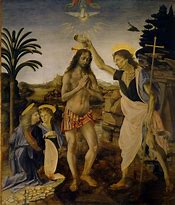
Leonardo da Vinci
Battesimo di Cristo
“In those days,” Saint Mark tells us next—that is, while John the Baptist was preaching—“ Jesus came from Nazareth of Galilee and was baptized by John in the Jordan.”
That sounds simple enough. But what did it mean? If John’s baptism was about “the forgiveness of sins,” and Jesus was sinless, why did he need to be baptized? If someone would give me an extra hundred dollars (or pounds, or euros—I’ve no prejudice against any major western currency) for every time I’ve been asked that question or something like it, I’d be quite a lot richer!
But the fact that we ask it shows that, died in the wool individualists as we are, we don’t really understand what either Isaiah or John the Baptist were talking about. What they were talking about was not the forgiveness of any particular individual’s sins—Jesus’ or anyone else’s—but the forgiveness of Israel’s sins. Jesus’ accepting John the Baptist’s baptism was an act of unity, of solidarity with his people, with the people of God. It joined him with those who did have things to repent—which is to say, it joined him with Israel—which meant, since Israel is also a part of the world’s history, that it joined him with humanity, with all of us. It was a sign that Jesus was, to use Matthew’s word, truly “Immanuel, God with us.”
And God greets that earthly sign, says the Evangelist, with a heavenly sign: “And just as he was coming up out of the water, he saw the heavens torn apart and the Spirit descending like a dove on him” (Mark 1:10). Just as the Spirit of God brooded like a dove over the face of the waters in the Genesis creation story, so the Spirit of God broods over Jesus in this union of God with us which is, as Saint Paul will later put it, “a new creation” (2 Cor. 5.17, Gal. 6.15), an act of God as wonderful and mighty, in its own way, as the first.
But at what cost?
“And a voice came from heaven, ‘You are my Son, the Beloved; with you I am well pleased’” (Mark 1:11). In Mark’s Greek these are the very words with which, in the Greek Old Testament, Abraham was told to take his beloved son Abraham and lay him upon the altar and kill him (LXX Gen. 22.2, 16). They are the words, again, that God will speak from heaven on the Mount of Transfiguration, as Our Lord is about to set his face to go to Jerusalem and death (Mark 9:7). And finally “God’s son” is the title that will be attested as Jesus’ own on Calvary, on this occasion not from heaven, but by none other than the pagan soldier who has just crucified him, whose conversion through the cross will stand as first fruit of the gentiles (Mark 15:39). That is how, being united with us even unto death on a cross, our Lord will finally fulfill that union of God with humankind which began when Mary conceived and as St John puts it, “the Word became flesh”: thereby binding God’s self to us in our weakness and sin, but by the same token also binding us to God in God’s glory and power.
And what is that to us? A millennium or so before Our Lord, King David sang, “Though I walk through the valley of the shadow of death, I will fear no evil, for thou art with me.” Three centuries or so after Our Lord, Athanasius of Alexandria observed, “The Word of God… became human in order that we might become God.” Many centuries after that, Austin Miles the Protestant hymn writer sang, “for he walks with me and he talks with me.” Our Lord’s uniting himself with Israel in its “baptism of repentance,” his uniting himself thereby with us, was a sign of that faithful union of God with God’s people, a sign that David and Athanasius and Austin Miles were right. And that is the sign that we celebrate today.
And now let us confess our faith…