

Individualism
Our forebears before the Enlightenment had in general a deep sense of human solidarity. It was not that they were unaware of people as individuals, or that they did not care for them as such. One has only to read Euripides or Shakespeare to see that that was not the case. But in general they saw human existence as having little meaning except in relationship to others. The Stoic Epictetus is not untypical:I will say that it is natural for the foot, for instance, to be clean. But if you consider it as someone's foot, and not merely as a detached object, it will be fitting for it to walk in the dirt, and tread upon thorns, and sometimes even be cut off for the sake of the body as a whole. Otherwise it is no longer a foot. We should reason in some such manner concerning ourselves also. What are you? A man. If then, indeed, you consider yourself merely as a detached being, it is natural for you to live to old age and be rich and healthy. But if you consider yourself as a man, and as a part of the whole, it will be fitting, on account of that whole, that you should at one time be sick; at another, take a voyage and be exposed to danger; sometimes be in want; and possibly it may happen, die before your time. Why, then, are you displeased? Do you not know that, just as the foot in detachment is no longer a foot, so you in detachment are no longer a man? For what is a man? A part of a city, first, of that made up by gods and men; and next, of that to which you immediately belong, which is a miniature of the universal city. (Discourses 2.5.24, trans. Elizabeth Carter, revised Robin Hard, revised Christopher Bryan)
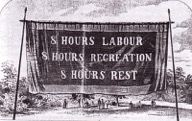 For a small country (population about 4.5 million) New Zealand has a surprising number of “firsts.” As early as 1890 it was the first country in the world to establish an eight-hour working day for craftsmen and laborers on the principle, “eight hours for labour, eight hours for recreation, and eight hours for rest.”