

Thoughts on the Holy Name of Our Lord Jesus Christ 2017
In Shakespeare’s Romeo and Juliet Juliet is frustrated that her love for Romeo is forbidden for no other reason than that he belongs to her family’s rival family, and has their name: What’s in a name? That which we call a rose / By any other word...
04 January, 2017
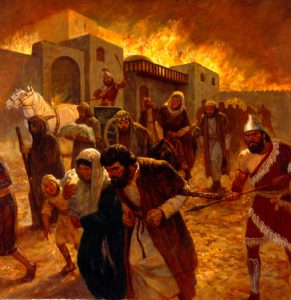 The prophet Jeremiah isn’t generally associated with being particularly upbeat or cheerful. The prophetic book that bears his name is dominated by his predictions of doom and destruction for Israel and her king, and the other Biblical book associated with him—Lamentations—though not actually by him, is a series of poetic laments over that destruction after it’s happened. It’s surely not an accident that Jeremiah’s name has entered the English language in the word “jeremiad”—which the Oxford Dictionary defines as “a very long sad complaint or list of complaints.”
Yet the readings from Jeremiah that we had last Sunday and this are actually rather hopeful and encouraging in tone, even though they date from a time when all Jeremiah's gloomy prophecies have come to pass. Jerusalem has fallen to the armies of Nebuchadrezzar, Israel is now in thrall to the pagan empire of Babylon, and many of her citizens have been forcibly deported to Babylon.
The prophet Jeremiah isn’t generally associated with being particularly upbeat or cheerful. The prophetic book that bears his name is dominated by his predictions of doom and destruction for Israel and her king, and the other Biblical book associated with him—Lamentations—though not actually by him, is a series of poetic laments over that destruction after it’s happened. It’s surely not an accident that Jeremiah’s name has entered the English language in the word “jeremiad”—which the Oxford Dictionary defines as “a very long sad complaint or list of complaints.”
Yet the readings from Jeremiah that we had last Sunday and this are actually rather hopeful and encouraging in tone, even though they date from a time when all Jeremiah's gloomy prophecies have come to pass. Jerusalem has fallen to the armies of Nebuchadrezzar, Israel is now in thrall to the pagan empire of Babylon, and many of her citizens have been forcibly deported to Babylon. 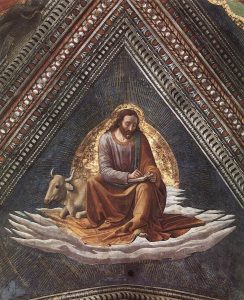 Domenico Ghirlandaio. St. Luke. c1488[/caption]
At the heart of his gospel Saint Luke presents us with a collection of four parables (Luke 15:1-16:8). They come in two pairs. We have a parable about a man (a shepherd with a lost sheep) matched with a parable about a woman (a housewife with a lost coin). Following those we have a parable about a father with two very difficult sons. That’s the parable that we usually call “the Prodigal Son,” although of course it’s as much about the elder brother who was not a prodigal as it is about the younger who was. And that parable is matched with the parable that the church, or at least those parts of the church that follow the Revised Common Lectionary, appoints to be read as a part of Proper 20 in Year C: a parable about a master with an unsatisfactory manager, or “steward” as the older translations generally have it.
Domenico Ghirlandaio. St. Luke. c1488[/caption]
At the heart of his gospel Saint Luke presents us with a collection of four parables (Luke 15:1-16:8). They come in two pairs. We have a parable about a man (a shepherd with a lost sheep) matched with a parable about a woman (a housewife with a lost coin). Following those we have a parable about a father with two very difficult sons. That’s the parable that we usually call “the Prodigal Son,” although of course it’s as much about the elder brother who was not a prodigal as it is about the younger who was. And that parable is matched with the parable that the church, or at least those parts of the church that follow the Revised Common Lectionary, appoints to be read as a part of Proper 20 in Year C: a parable about a master with an unsatisfactory manager, or “steward” as the older translations generally have it.