

27 May Thoughts on Easter 5A: The Way, the Truth, and the Life
For the Gospel: John 14:1-14
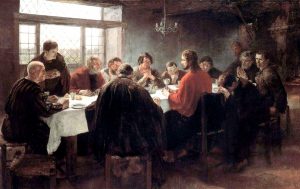
The Last Supper by Fritz von Uhde (1886)
Jesus said, “Do not let your hearts be troubled. Believe in God, believe also in me. In my Father’s house there are many dwelling places. If it were not so, would I have told you that I go to prepare a place for you? And if I go and prepare a place for you, I will come again and will take you to myself, so that where I am, there you may be also. And you know the way to the place where I am going.” Thomas said to him, “Lord, we do not know where you are going. How can we know the way?” Jesus said to him, “I am the way, and the truth, and the life. No one comes to the Father except through me. If you know me, you will know my Father also. From now on you do know him and have seen him.”
Philip said to him, “Lord, show us the Father, and we will be satisfied.” Jesus said to him, “Have I been with you all this time, Philip, and you still do not know me? Whoever has seen me has seen the Father. How can you say, ‘Show us the Father’? Do you not believe that I am in the Father and the Father is in me? The words that I say to you I do not speak on my own; but the Father who dwells in me does his works. Believe me that I am in the Father and the Father is in me; but if you do not, then believe me because of the works themselves. Very truly, I tell you, the one who believes in me will also do the works that I do and, in fact, will do greater works than these, because I am going to the Father. I will do whatever you ask in my name, so that the Father may be glorified in the Son. If in my name you ask me for anything, I will do it.”
As our gospel reading for today begins, we are in the upper room with Jesus and his disciples on what it is to be the last night of his earthly life. And three things have just happened—three dreadful things. The first is that Judas, one of the twelve, has just left them and gone out into the night to betray Jesus. Second, Jesus has told the rest of them that he’s about to leave them, and that where he’s going, they can’t come. From now on, it seems, they are to be on their own. Third, Peter has protested at this and said he’s willing to lay down his life for Jesus, so why can’t he come with him? And Jesus in reply and has told Peter that before cock crows he will deny Jesus three times.
So this is not a happy moment. But it’s the moment when our gospel story this morning begins—a moment, surely, of disappointment and even despair. And that’s the moment when Jesus says, “Don’t let your hearts be troubled. Trust in God, and trust in me.”
But how can they trust him? How can they believe in him? He’s just said he’s about to bail out! He continues, “In my Father’s house,” he says, “there are many dwelling-places. If it weren’t so, I would have told you.”
So why is he leaving them? “I am going to prepare a place for you,” he says. “And if I go and prepare a place for you, I will come again and will take you to myself, so that where I am, there you may be also.”
Scholars have been arguing for millennia about what exactly Jesus meant by all this, or even what the evangelist may have thought he meant. What are the “dwelling places”? And when Jesus says he will come again, is he talking about his resurrection appearances or his final coming in glory? I certainly don’t intend to try to answer those questions here. But even without answering them, we can surely see a general message in Jesus’ words that is clear enough. In essence he is telling them, “I know what I am doing. My departure is for a reason.”
“And,” he adds, “you know the way to the place where I am going.”
At which point Thomas, apparently, loses it.
“Lord,” he bursts out, “we don’t even know where you are going! How can we know the way?” We might reasonably flesh out Thomas’ question a little more: “We all know you’re in trouble with the authorities, Lord. By this time tomorrow you could be in a dungeon in Herod’s palace or at the Praetorium, or you could be hanging on a Roman cross. So what’s all this about us knowing the place where you’re going and therefore knowing the way?”
It’s a reasonable question. An honest question! And Jesus always takes reasonable questions seriously. So now he answers Thomas with words that have echoed down the centuries. How can you know the way? “I am the way,” he says, “the truth, and the life.”
“I am.” The Greek here is very precise. There is a pronoun, not required grammatically, which means that it is emphatic. I, in boldface type, so to speak: a choice of expression that requires Thomas to turn his attention away from thoughts or doubts or fears about what he may or may not believe to the one certainty, which at that moment is the person standing in front of him, the person of Jesus himself.
“I am THE WAY.” The evangelist’s Greek in the predicate is also precise. There is an article before the noun—which is not normal in Greek when a noun follows the verb “to be”. And what that means in this case is that the claim is absolute.[1] Not “I am a way”—I have a cunning plan, chaps, which might work!—but I am THE way—the appointed way, God’s way.
So the question for Thomas, the question for the disciples, the question for each one of us, has suddenly become very simple. “Do you trust me?” Jesus asks. “You want to know the way you should go, the way for life, the way even in death? I am the way.”
My neighbour, a seminarian, has to leave his house at the end of the month, and he doesn’t yet have a job. Now in what I’m about to say I certainly don’t mean to convey that he is being improvident or lackadaisical. He’s pursuing all proper channels, has some good prospects, and also has made sure that there is somewhere for his family to live for a while if the right job doesn’t surface in time. But he and his wife still face their imminent move amid a lot of uncertainty—and face it with impressive calm.
“You are like Abraham, setting out not knowing where he was going,” I said to him on Thursday. (If you want a neighbour who can provide you with a fairly useless biblical quotation to comment on your situation, I am probably your man.)
He smiled gently. “Yes,” he said, “I suppose we are.”
Then I went home and started to prepare this sermon. And I saw why he and his wife are so calm. In many senses, as the world counts knowing, they don’t know where they are going. They can’t see the way ahead. But they do know Christ. And he is their way. The rest is just a matter of details.
“You want to know the truth?” Jesus continues. “I am the truth.”
Not, of course, only truth as accuracy, precious and important though that is. (If we state something as fact, we should try to make sure that it is a real fact—something that some of our politicians seem to have forgotten lately.) But more than that! In a writer as Jewish as our evangelist, we are surely to understand the truth as the Hebrews understood the word emet—the truth you can rely on, the truth you can trust, the truth that will not let you down. There’s only one truth of which we can say that, and it’s the truth of God—which means, not a truth that you can learn about and then move on, but a truth that once found you must live with for ever, since there is nowhere else to go: the truth of the incarnate revelation of the Father, full of grace and truth.
“You seek life?” Jesus says. “Of course you do. Well, I am the life.”
“The life”—and again, the claim is absolute. This is the life behind all life, the life that God gives, the life of the Divine Breath, ruach elohim, the Spirit of God, as moving over the barren waters of chaos, when God said, “Let there be light,” and there was light. That light, as St John has already told us in his prologue, is in Jesus the incarnate Word, and that light is the life of humankind.
So—Jesus Christ is “the way, the truth, and the life.”
“The way” where?
“The way” to the Father, of course! Our way to the One in Whom all other ends are summed up and fulfilled. He is the way, the true way, the only way, which means—“No one comes to the Father except through me.”
Now I hope I don’t need to point out that our Lord is NOT here saying, “No one comes to the Father unless they’re a Christian.” That, in fact, is precisely what he is NOT saying. (Can you imagine the one who was remembered as rebuking his disciples when they spoke ill of someone who wasn’t of their group, can you even imagine him saying that? Of course you can’t.) And the fact is, as Bishop Westcott wisely wrote in comment on this very passage, “It does not follow that everyone who is guided by Christ is directly conscious of his guidance.” Exactly. We Christians have the privilege of having the faith, the sacraments, the Scriptures, the creeds—those places and formularies where the guidance of God in Christ is promised. And we will be wise to make use of them! But as a truly catholic Christianity has always pointed out, that doesn’t mean that God is limited to those things. No—what we should hear our Lord saying here is essentially what he says elsewhere in the gospels, “By their fruits you will know them. Wherever you see the fruits of my presence—wherever you see compassion, grace, truth, love, faithfulness—be sure that I am at work, whether I am known by name or not.”
But meanwhile, what of those of us who do have the privilege of knowing who is the One who guides us? “If you know me,” Jesus says, “you will know my Father also. From now on you do know him and have seen him.” To know him—again, in a writer so Jewish as the fourth evangelist, we may be sure that the word is used in its full biblical sense. “To know” in the sense of “to acknowledge”—this is the Bible’s word to speak of Israel’s true relationship to God. “You shall know no other God but me,” God says to Israel through the prophet Hosea, and the prophet Jeremiah promises that in the days of God’s new covenant, “they shall all know me, from the least of them to the greatest.” That promise, Jesus is saying, is fulfilled for those who follow him.
But then Philips says, “Lord, show us the Father, and we will be satisfied.” Heaven only knows what Philip thinks he’s asking for. A vision like Moses at Sinai? An out-of-the-body experience? An altered state of consciousness? Who knows? But notice how Philip has in fact changed the vocabulary. He is not speaking of knowledge, as his Lord spoke—the knowledge that can only come through relationship, commitment. He is talking, literally, of a show. Show us!!
Our Lord responds to what Philip’s has said, but also gently corrects his vocabulary. “Have I been with you all this time, Philip, and you still do not know me?” This is about relationship, Philip, not about show and tell!
What Jesus calls us to is a relationship with himself, and with God through him. We are to know him, to know his mind, always seeking the mind of Christ: and if we seek the mind of Christ, then we may be assured that we will be “shown” whatever we need—perhaps it will indeed be like Moses at Sinai, or perhaps it will just be the knowledge of his closeness to us in the daily round, the common task. But either way, or any other way, Our Lord himself assures us, “Whoever has seen me has seen the Father.”
Our Lord goes on to speak of himself as the Agent of the Father, using the rabbinic concept of the shaliach, or representative—that is, one who in the matter for which he is sent always to be accepted as the One who sent him. “The words that I say to you,” he says, “I do not speak on my own; but the Father who dwells in me does his works.”
Then, finally, Our Lord touches on the power that is given to those who believe in him. “Very truly, I tell you, the one who believes in me will also do the works that I do and, in fact, will do greater works than these, because I am going to the Father.” This is an extraordinary promise—and yet one amply fulfilled in the history of the Christian church, spread into every nation, to cultures and languages far beyond the conceiving or possibilities even for Our Lord in his incarnation. And yet even that is not the final promise: “I will do whatever you ask in my name, so that the Father may be glorified in the Son. If in my name you ask me for anything, I will do it.” This promise is not, of course, to be understood in isolation from the conversation that has preceded it.[2] It is not a blank cheque! It is a promise made in the light of all that conversation, which means that is made to us
as believers,
as those who earnestly seek the mind of Christ,
as those who will open their hearts to the Spirit that God is about to send,
for those who seek the mind of Christ and are open to God’s Spirit will be careful never to ask for anything trivial or contrary to God’s will. On the contrary, their prayer will always be the prayer of Our Lady, the perfect model for all disciples, as she cries joyfully, “Behold the Lord’s handmaid. Be it unto me according to thy Word.” Even in moments of stress, grief, or danger, when we may certainly pray for deliverance, still our prayer will be the prayer of Our Lord in Gethsemane—“Father, if it be possible, let this cup pass from me. Nevertheless, not my will but thine be done.”
Such prayer, we may be sure, will always be answered. And as God vindicated His Son, we too shall be vindicated by the One God, Father, Son, and Holy Spirit, to Whom we now ascribe, as is most justly due, all might, majesty, dominion and power, now and forever. Amen.
[1] One case where the article may be found in the predicate after the verb “to be” is where (as in John 14.6) it indicates an individual or thing identical with the subject, so that the proposition is in fact reversible. We might equally well say, “The way [to the Father] is Christ,” and so on. See Maximilian Zerwick S.J. Biblical Greek (Rome: Pontificio Instituto Biblico, 1990) § 174.
[2] One might add that it is also not to be understood in isolation from what follows it—that is, the promised gift of the Paraklete, who is to guide us “into all truth.”