

27 Dec The Word became flesh: text of a sermon preached at St Stephen’s, Exeter on Christmas Day, 2019
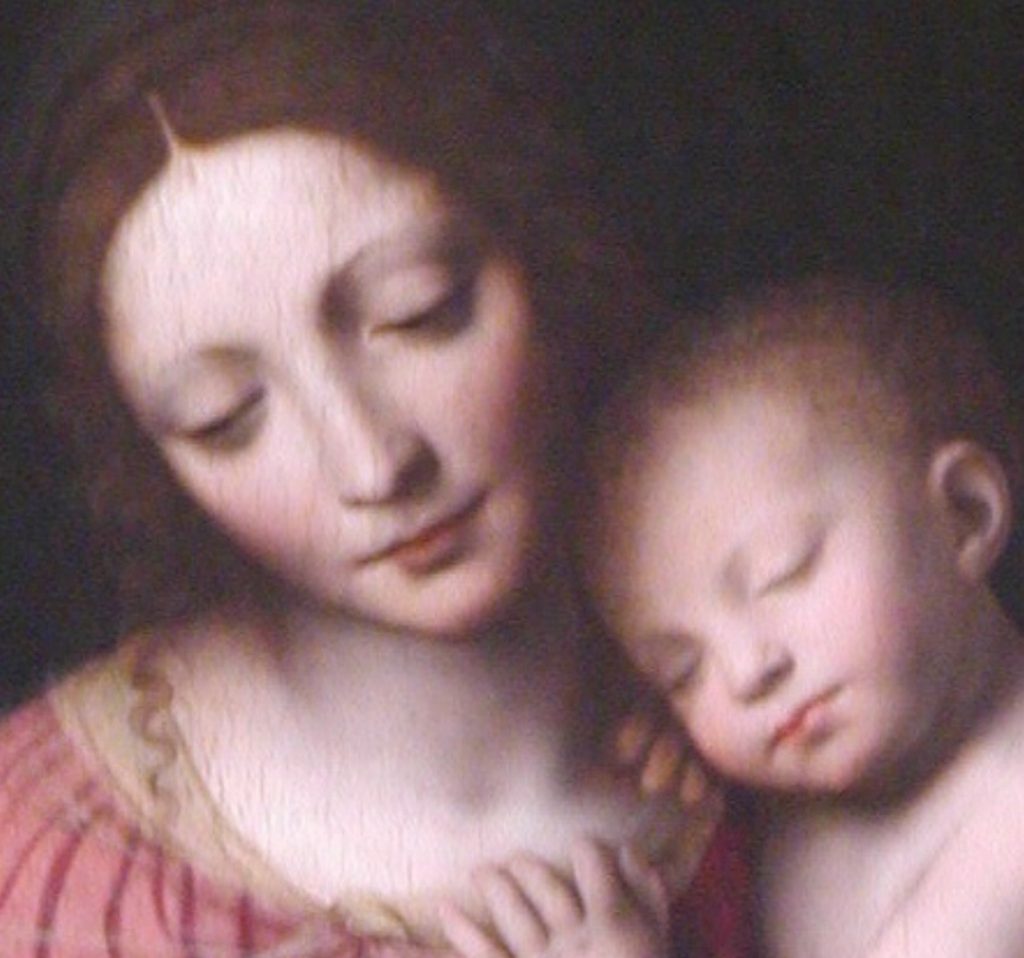
For the past few years, whenever I’ve preached at Christmas it’s generally been at Midnight Mass. That means, of course, that I’ve preached on St Luke’s story of Our Lord’s birth: Mary and Joseph coming to Bethlehem, no room at the inn, the stable, the shepherds’ visit, and at the centre of it all the Virgin Mother and her Child. And what a story it is! Even after two thousand years painters still love to paint it, sculptors to carve it, and poets and hymn writers to hymn it. Countless schools and churches around the world love to reenact it. The most cynical and morally beaten-up among us generally still have a moment when our hearts are strangely warmed as we gather round a Christmas crib or watch a Nativity Play, however simply (or even badly) written or performed.
That, then, is what we get to think about at Midnight Mass.
By contrast, in the light of Christmas morning, while not forgetting that wonderful story—our hymns are still reminding us of it—while not forgetting that, the church now asks us to pay attention to the passage from St John that we just heard, the Prologue to his gospel. In it John tells us his version of the same story. And it’s different. Very different! Moving from Luke’s stable to John’s Prologue is like moving from a cosy thatched cottage to a solemn temple.
John’s version begins back in time, indeed, before time. No doubt the evangelist had read in his Bible that “in the beginning” God created the heavens and the earth. So he now starts by pointing out that what was “the beginning” for us was, of course, by no means the beginning for God! Already at that “beginning”, and even before God created anything, “the Word”—God’s Word—already was! (1.1) Through that Word, he tells us, the universe itself was uttered into being (1.3). In that Word was life, and the life was the light of humankind—the true light, that enlightens us all, the light that continues to shine throughout our history (1.4). And although that history contains much that is dark, still “the darkness did not overcome” it (1.5)—the “overcome” of our NRSVs being something of an under-translation: John’s Greek word is “κατέλαβεν”—”grasped” or “apprehended” — a rather brilliant choice, since it implies not only that darkness has never defeated the light but also that it has never understood it (1.5). As the colloquialism has it, when it comes to light, the darkness has simply never got it.
After a couple of digressions about John the Baptist and other things, John comes to the affirmation that is heart and centre of the Christmas story as he tells it: “the Word became flesh, and dwelt among us.” “Flesh”—σάρξ: a word that to John’s first hearers would have spoken of our humanity in all its frailty and transience. I dare say neither John nor his hearers could think of anything more utterly different from God’s eternal Word than “flesh”, and yet “flesh” is what John says the eternal Word “became”—ἐγένετο: his choice of word indicating what happened here was no mere appearance, like an actor putting on a costume or a mask, but real.[1] St Augustine of Hippo declared that throughout his life before he became a Christian, as he struggled to find wisdom, he’d come across other sources that spoke to him of God’s Word. But only in Christianity did he find it written that “the Word became flesh” (Confessions VII).
Just why does the church want us to hear all this—in effect, a summary history of the universe—on this particular day? I think because it tells us something of what the Bethlehem story means. It’s only too easy for us to sentimentalise that story. We can hear it and at the end of it say, “Yes, it’s beautiful. But it was all a very long time ago. Next week we must go back to work and the world will not have changed. Life will still be the same old same old.”
And that’s precisely where St John says we’re wrong. “No,” he says. “If you think that, you simply haven’t got it. You’re like the dark that surrounds the light but never understands it. What happened at Bethlehem that night involved a union between ourselves and God that changes everything, a union that is staggering if not preposterous, a colossal, breathtaking paradox. Don’t you hear it? The Word became flesh.”
For all the lightness of her verse, Christian Rosetti expresses that paradox very firmly in her carol, “In the bleak midwinter” [2]—indeed, she compels us to pay attention to it:
Our God, heaven cannot hold him,
Nor earth sustain;
Heaven and earth shall flee away,
When he comes to reign.
So much any follower of the God of Abraham, any faithful Jew, Moslem or Christian may affirm. But then comes the affirmation that only a Christian can make:
In the bleak midwinter
A stable place sufficed
The Lord God Almighty,
Jesus Christ
It is precisely our humanity, our back-to-work-and-the-world-hasn’t-changed humanity, our it’s-only-more-of-the-same-old-same-old humanity, which God has consecrated and tied to God’s own self in the birth of Jesus Christ. That’s what John tells us. The Word has become flesh.
And just why would God do such a thing as that? John’s answer to that question comes only a little later in the gospel, in what’s understandably one of the best-loved verses in the Bible. God did it, John says, because “God so loved the world” (3.16). Though God needs nothing and has perfection within the Triune Unity, still God, one of Whose names is “Immanuel, God with us”, wills to be in union with a creature who is other than God’s Self—and for no other reason than love. God wants us to be (as 2 Peter puts it) “partakers of the divine nature” (1.4). And since we in our frailty cannot attain to God, God in God’s loving-kindness comes to us. Love is why God in the child of Bethlehem tied God’s self indissolubly to us, even though, in the sinful world that humankind had made, it would cost him the cross.[3] And love is why at the end of the gospel story, when Christ is exalted to the right hand of God, it will be our humanity that is exalted with him and in him. “Beloved,” says John’s first letter, “even now are we children of God, and it does not yet appear what we shall be: but we do know this, that when he appears we shall be like him, for we shall see him as he is” (1 John 3.2).
And that is why the church, amid and in spite of all the darkness and confusion that is in the world, continues to wish us all a Merry Christmas. Amen.
[1] The evangelist’s choice of word excludes “any possibility that the human flesh of Jesus was something similar to clothing which he had put on, something quite external to him, which he could discard at will… This does not mean that the Logos was changed into a human being.… Nor does the use of ἐγένετο imply that the Logos ceased to be God. The sense is that the Logos became a human being without ceasing to be God. Thus the purpose of ἐγένετο is to emphasize that the Logos did not just ‘dwell in’ human flesh, did not just ‘have’ a human body in order to speak his part for one or more performances, like a Greek actor walking on stage with a particular mask. He, the divine Logos, was in reality the principal character in the drama” (John F. McHugh, A Critical and Exegetical Commentary on John 1–4 ICC [London: T & T Clark, 2009] 53).
[2] First published as “A Christmas Carol” in Scribner’s Monthly (January 1872) 272; now in The New English Hymnal 28; The Hymnal 1982 112.
[3] There is a school of thought, particularly prominent in the Eastern church, which says asserts that it was always God’s purpose to become incarnate, even if humanity had not sinned. While such “what-would-have-happened-if” questions are surely close to being meaningless, and in any case I am certainly not qualified to have an opinion on the matter that would be worth much, still, for what it is worth, I confess that this is an idea that I find attractive.