

19 Nov Thoughts on Joshua and The Promised Land: text of a sermon preached at the Convent of St Mary, Sewanee, on Sunday 12th November 2017 (Proper 27, Year B)
For the Old Testament Reading: Joshua 24:1-3a, 14-25.
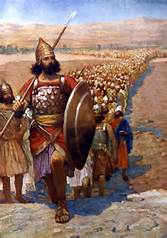
I’d like to spend a few minutes with you this morning looking at our Old Testament lesson. It’s a dramatic and memorable scene—even somewhat iconic. It begins with Joshua gathering together the elders, heads, judges and officers of Israel—all the movers and shakers, so to speak—and reminding them of what God has done for them. He does this at some length, and the compilers of our Lectionary, perhaps fearing our attention span is less than the Israelites’ (as indeed it probably is) have omitted quite a lot of it—ten and a half verses, to be exact—as you’ll notice if you check the story in your Bibles after Mass. Anyway, Joshua reminds them how God has delivered them from bondage and given into their hand the Promised Land, the land of the Amorites and six other nations.
“So,” he says at the end of it all, “worship the Lord, and serve him! Put away the gods of your ancestors!… choose this day whom you will serve! As for me and my house, we will serve the LORD.”
Surely this stirring stuff! “As for me and my house, we will serve the LORD!” The chap who used to come and do my plumbing had those words painted on the side of his van.
But wait a minute!
“Choose this day whom you will serve… Put away the gods of your ancestors” ?
Now that’s a bit odd, isn’t it? Can it really be that after all God has done for this people they still have their old gods with them? Apparently, it can. Still, they do seem to have got the right idea now: “Far be it from us that we should forsake the Lord to serve other gods!” they say. “We will serve the Lord, for he is our God.”
Joshua, however, doesn’t seem very impressed. “You can’t serve the Lord!” he says.
Why?
“Because the Lord is a holy God, a jealous God” – el qana in Hebrew, which means “a passionate God, a lover who will brook no rival.” “If you forsake the Lord,” Joshua continues, “and serve strange gods, then the Lord will turn and do you evil, and consume you!”
Perhaps Joshua is relying on counter-suggestibility? If so, it works, for the people now insist they’ll be faithful.
“No, we will serve the Lord.”
Even then Joshua’s response isn’t exactly dripping with enthusiasm.
“You are witnesses against yourselves,” he says, “that you have chosen the Lord, to serve him.”
You are witnesses against yourselves! Joshua still seems virtually to assume that they’re going to fail. And they for their part seem to accept it, for their reply, “We are witnesses,” is terse and ambiguous. Actually it’s even more terse and ambiguous in Hebrew than it is in our English Bibles, for it consists of a single word. It’s as if they just nod their heads and say resignedly: “Edim – witnesses.”
Still, it seems to be enough. Joshua again says they must put away their foreign gods and serve the Lord, the people answer that they will serve and obey the Lord, Joshua makes a covenant with them, and the scene ends happily.
Or does it? Even then it isn’t without ambiguity. If you were listening carefully to the reading you may have noticed that though the people say they’ll accept Joshua’s second demand and serve the LORD, they don’t actually say they’ll accept the first, and put away the foreign gods. Nor does the narrative say that they did.
Now we might argue that their putting away foreign gods was implicit in their pledge to serve the Lord and in Joshua’s making a covenant with them. Yes, we might. And I am perfectly familiar with the old legal tag–res ipsa loquitur: the thing speaks for itself. But in this particular case, does that really apply? The putting away of other gods is, after all, a key point at issue, and surely it is rather strange that the narrator should have left the resolution of this issue to be inferred? That the possibility should be left open that Israel might still turn to some God or gods other than the LORD who’d redeemed her from Egypt? That in addition to the LORD, she might still seek to serve other gods?
But that’s not the only thing that’s strange about this passage. I have quite a different problem with it, and it’s this: what about those Amorites whose land, according to Joshua, God has given to Israel?
I ran over that part of the story quickly just now, just as our lectionary does by leaving most of it out – but it’s in the Bible all right. Joshua reminds the Israelites how God brought them out of Egypt where they were being oppressed by the Egyptians, and led them into the Promised Land so that… so that… so that what? So that they could then oppress the Amorites! And indeed oppress them rather worse than the Egyptians had oppressed them—exterminate them, to be exact, and then live in their houses and use their vineyards. What an irony is here!
I read somewhere some years ago – to my irritation I can’t remember where – about someone visiting an archaeological museum where there were lots of things on display that had belonged to the ancient Amorites – pretty combs that girls probably used for combing their hair, and children’s toys. I wonder what they were like? Who were those girls who used those combs, and the children who played with those toys? Were the children sometimes affectionate and sometimes horrid – like most of us? Were the girls sometimes nice and sometimes nasty – like most of us?
But then, it really doesn’t matter, does it? For whatever they were like, the message to the people of God is clear: “you must utterly destroy them. Make no covenant with them and show them no mercy.” That’s what Moses had commanded Israel apropos the Amorites and those six other nations way back in the Book of Deuteronomy (7:2). So as for Joshua this morning, he was just obeying orders. Who cares what the Amorites were like?
Now even granted the Scriptures’ premise, that Israel is the chosen of God – which, indeed, I do grant heartily – still this sounds horrific. Israel the chosen is to be a source of utter destruction to the nations round her. Is this then the good news of God? Is this what Israel, and later also the Church, is to teach the world about God’s justice and mercy?
My first move, since I’m one of those pesky academics, is naturally to point out that this is theological fiction, designed to show the strength and depth of the Lord’s commitment to Israel. There were never really seven such nations as Deuteronomy names existing at one time for Israel to exterminate, and Israel didn’t really behave as badly as Moses seems to have said she should.
Well, maybe so. But does that solve the problem? Actually, it doesn’t. In fact I think it makes it worse. After all, if this were simply history, one might reasonably say, “Well that was then but this is now.” But if this is theological fiction, then it’s a sort of symbol, a myth, if you will, of God’s dealing with God’s chosen. And the trouble with symbols is that they are transferable. You have only to decide that in the present situation you are God’s chosen and hey presto! – You can be perfectly clear and comfortable with knowing that God allows you behave toward people who aren’t like you or don’t have the same faith as you or don’t think like you or even happen to live in a country that you want to live in, in ways that in any other context you’d call cruel, dishonourable, and disgraceful. Ethnic cleansing, slaughter of non-combatants, murdering their children—what’s the problem? Jon D. Levenson, a Jewish biblical scholar whom I greatly admire, has suggested there’s a parallel between the Jews’ rapacious negation of the nations who had preceded them and the way in which Christians later rapaciously superseded the Jews.[1] Alas, I think Levenson is right. And throughout the next two thousand or so years we can see this theological fiction in one version or another being taken to provide biblical warrant, directly or indirectly, for all sorts of abominable nonsense:
Christian anti-semitism,
the burning of heretics,
the Christian rape of lands from their previous inhabitants (including, of course, those lands that we now call “the United States”),
babble about “master races”, “manifest destiny” and “exceptional nations”
modern Israel’s right to oppress Palestinians on the grounds that “God gave us this land,”
and by bitterest irony, the only too evident involvement of Christians in the Nazi holocaust, wherein Israel herself became the Amorite to be exterminated, while in German society at large Jewish wives of Aryan men became the “foreign women” who must be put away lest the purity of the race be compromised (cf. Ezra 10.1-12).
No, I’m afraid just saying, “Israel’s call to exterminate the Amorites is theological fiction,” won’t fix it.
As always when this kind of problem arises in Scripture, we must go further into Scripture itself. The fact is, there are many voices in Scripture, and they don’t all say the same thing. Indeed, the Bible has a habit of giving us what Walter Brueggemann calls “testimony and counter-testimony”–one set of ideas and possibilities seeming to be presented in opposition to another, so that there is in effect an argument going on! Now I must be careful here. I’m not saying that everything in Scripture is up for grabs. Quite the contrary! There are some things—indeed, some fundamental things—that are quite clear and consistent and unambiguous throughout Scripture, such as the proclamation of God’s faithfulness to Israel, and God’s grace and call to us in Jesus Christ. But there are other issues, important issues, where we seem to be listening to a debate.
And so it is with the matters we are considering now. If we listen carefully to the Bible as a whole, we soon hear other voices telling us a story quite different from that implied by Joshua in our reading this morning– a story, moreover, that on Scripture’s own testimony is far older and deeper than Joshua’s, for it begins with the creation of the world wherein the Creator sees all that is made as very good (Gen. 1:31).
This story comes to fuller bloom in Genesis 9, where we discover that God’s primary covenant is not with God’s chosen people, nor even with humanity, but with “every living creature of all flesh”(9:9, 15). What’s more, this primary covenant is an everlasting covenant – beryt olam – it cannot be done away (9:16).
As for Israel as God’s chosen, Abraham is told what that means. Far from meaning that Israel is to destroy other nations, God tells Abraham that Israel being God’s chosen means the very opposite of that: “in your seed, all the families of the earth shall be blessed” (Gen. 12:3; cf. 22:18). This idea is wonderfully developed in the Second Isaiah’s words to God’s servant— “It is too light a thing that you should be my servant to raise up the tribes of Jacob and to bring back the preserved of Israel; I will make you as a light for the nations, that my salvation may reach to the end of the earth” (49:6)—and these words are in turn said of the infant Christ by the aged Simeon in the Temple at Jerusalem–Simeon’s song that we recite every evening at the evening office: the Nunc dimittis. Jesus himself is the light to enlighten the nations, and also the glory of his people (Luke 2:29-32).
In investigating our scriptural passage this morning it seems then that we have noticed not one but two pairs of conflicting stories reflected in it about the world in which we live. One pair opposes a story in which God is our only saviour and Lord to a story in which we may worship many gods and many lords. The other pair opposes a story in which God cares for all that God has made to a story in which God cares only for those who have been named as God’s elect, the chosen people.
Of course, in neither case are the two stories simply set side by side as of equal merit. It’s perfectly clear in both Old and New Testaments that to accept the God of Israel as Lord is the only true path; to live by that other narrative, the narrative involving other gods, is to walk a path to destruction.
And there is good reason to argue that Scripture privileges the story of God’s universal generosity and good will over the story of God’s violence. Not only is it, as we’ve just seen, the original story, the story of creation: it’s also the final story – in the rabbinic canon of scripture the last word, quite literally. The closing word of the rabbinic canon – in our Christian Bibles the last word of 2 Chronicles – is ve-ya’al – “let him go up.” It is a word of grace, hope, and encouragement uttered to Israel, under God, by a pagan emperor who will with pagan funds rebuild the Lord’s Temple at Jerusalem: in other words, it speaks of nothing but good will between Israel and the other nations. And of course that aliyah – that “going up” to Jerusalem is the same aliyah, the same going up, that is promised in the prophets and the psalms to all the nations (Isa 2:2-4; Micah 4:2; Ps 72).
As for the New Testament, let it suffice for now to note that in it our Lord himself declares that when he is lifted up he will draw all people to himself, and the Letter to the Colossians declares that God wills to reconcile all things in His Son, bringing peace by the blood of his cross (John 12:32, Col. 1:20; cf. also Rom. 11:32, Eph. 1:10, 1 Tim. 2:3-4).
All that granted, it remains that our scriptures do not dismiss this story of God’s meanness nearly so clearly or straightforwardly as they dismiss the story that there are many gods whom we might worship. And the clearest evidence of that is that there remain to this day Christians in certain traditions who will claim that only those who are members of God’s people—and often that membership is often defined by them quite narrowly—can have any hope of salvation. And such Christians can claim, not without reason, that they are following the Holy Scriptures, or at least a part of them.
This is not, of course, the only issue where it must be admitted that well-meaning people seem able to extract from the Bible entirely opposite stories. Another such has been slavery, where until late in the nineteenth century there were still those who would claim from the pulpit that God had ordained slavery, pointing to texts such as “Slaves obey your masters!” as justification for their view. Of course there were those who took the opposing view, pointing out that God had also said, “Let my people go!” It remains, however, that those who defended slavery were not totally without Scriptures to which they could appeal.
And still other issues remain hot button topics for some until this very day. Relationship between the sexes—patriarchy versus equality between the sexes—is one such issue, and same sex marriage another. Here, too, both sides find texts of Scripture to which they can appeal.
Why then do the Scriptures leave us with such confusion? Why, in the particular matters we have been considering this morning, do they leave us two narratives, so that we have to choose between them? Why did synagogue and church not simply expunge the narrative of God’s meanness and leave the only the narrative of God’s generosity – as, indeed, our Lectionary devisers may have been attempting to do by their omissions this morning?
The answer, I suspect, is quite simple. The people of God, now as in the past, are a work in progress. Those who created our Scriptures—those who wrote them and those, under God, who in the centuries following selected them to form the church’s canon—they themselves were a part of that work in progress. Our Lord promises in the gospel that the Holy Spirit will guide us into all truth (John 16:13 cf. 14:26). He does not promise instant awareness of all truth! Guidance is a process. So is teaching. Even St Paul admitted that he did not always know what to pray, or what to pray for[2]—which is as much as to say, he admitted that he did not always know what was right nor what was the will of God. Nor, of course is this process of becoming by any means confined to the people of God, however much we may rejoice in our chosen-ness. As the Apostle points out, God cares for all that God has made and desires that all shall come to a knowledge of the truth (1 Tim. 2:3).[3]
As always, then, we must be patient with those who came before us, with those who wrote our Scriptures and those who gathered them together, as well as with ourselves, with each other and with the church. And especially we must be patient over questions where persons of faith and goodwill have disagreed and may continue to do so. Even when we are broadly in the right over a particular issue, let us never forget that the chances are there is still more to be said, and that there are some things that we have not yet thought of and in this life perhaps never will! God has not finished with us yet–and that is not bad news, but good! In that hope and confidence, let us then confess our faith, as the church has taught us: We believe in One God…
[1] Jon D. Levenson, “Is There a Counterpart in the Hebrew Bible to New Testament Anti-Semetism?” Journal of Ecumentical Studies 22 (1985) 242-60.
[2] Romans 8:26. With St Jerome, the KJV and Douey-Rheims, I here translate Paul’s τί correctly, as opposed to the NRSV and other modern versions.
[3] I am reminded of Charles Kingsley saying all this rather nicely for young children back in the middle of the nineteenth century when he wrote of the ancient Greek myths:
Now, while they [the Greeks] were young and simple they loved fairy tales, as you do now. All nations do so when they are young: our old forefathers did, and called their stories ‘Sagas.’ I will read you some of them some day–some of the Eddas, and the Voluspa, and Beowulf, and the noble old Romances. The old Arabs, again, had their tales, which we now call the ‘Arabian Nights.’ The old Romans had theirs, and they called them ‘Fabulæ,’ from which our word ‘fable’ comes; but the old Hellenes called theirs ‘Muthoi,’ from which our new word ‘myth’ is taken. But next to those old Romances, which were written in the Christian middle age, there are no fairy tales like these old Greek ones, for beauty, and wisdom, and truth, and for making children love noble deeds, and trust in God to help them through.
Now, why have I called this book The Heroes? Because that was the name which the Hellenes gave to men who were brave and skilful, and dare do more than other men. At first, I think, that was all it meant: but after a time it came to mean something more; it came to mean men who helped their country; men in those old times, when the country was half-wild, who killed fierce beasts and evil men, and drained swamps, and founded towns, and therefore after they were dead, were honoured, because they had left their country better than they found it. And we call such a man a hero in English to this day, and call it a ‘heroic’ thing to suffer pain and grief, that we may do good to our fellow-men. We may all do that, my children, boys and girls alike; and we ought to do it, for it is easier now than ever, and safer, and the path more clear. But you shall hear how the Hellenes said their heroes worked, three thousand years ago. The stories are not all true, of course, nor half of them; you are not simple enough to fancy that; but the meaning of them is true, and true for ever, and that is—“Do right, and God will help you.” (Charles Kingsley, Preface to The Heroes, or Greek Fairy Tales for My Children [London: William Clowes, 1856]).
It may be worth my saying, incidentally, that I absolutely adored Kingsley’s The Heroes when I was about nine, and if anyone wants to introduce their children to the ancient Greek myths in a way that is not confusing for children who are being brought up as Christians, I can only say that The Heroes seemed to work for me (not, of course, that I thought about that at the time!). Kingsley was himself a devout Anglican priest, as well as a classical scholar, so this was an issue that mattered to him.