

27 May Thoughts on Easter 6A: The Promise of the Paraclete
For the Gospel: John 14:15-21
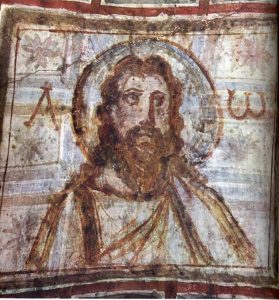
Christ, Alpha and Omega, Beginning and End, Mural from the catacomb of Commodilla, late 4th century.
Jesus said, ”If you love me, you will keep my commandments. And I will ask the Father, and he will give you another Advocate, to be with you forever. This is the Spirit of truth, whom the world cannot receive, because it neither sees him nor knows him. You know him, because he abides with you, and he will be in you.
”I will not leave you orphaned; I am coming to you. In a little while the world will no longer see me, but you will see me; because I live, you also will live. On that day you will know that I am in my Father, and you in me, and I in you. They who have my commandments and keep them are those who love me; and those who love me will be loved by my Father, and I will love them and reveal myself to them.”
Prologue
This morning’s gospel continues from where we left off last week. We are still listening to the Evangelist St John. We are still in the upper room at the Last Supper with Jesus and his disciples. Last week, you may remember, Jesus was responding to the disciples’ fear and consternation over the fact that he was about to leave them. By way of both encouragement and comfort, Our Lord spoke of himself as the Way to the Father, and of the grace that would come to his disciples through their relationship to him. This week he goes on to speak more specifically of that grace.
Loving Jesus
“If you love me,” he says, “and if you keep my commandments”—I know that isn’t exactly what the NRSV says, but I think it’s the better reading[1]—“If you love me and keep my commandments”… but what does it mean, to “love Jesus”? The Greek word is agapan, the usual New Testament word for “love”, and many scholars and theologians since the 1930s and 40s—and I’m sure you’ve heard preachers doing this too—have insisted on making a pretty hard distinction between that kind of love, the love that the Greek New Testament refers to as agapē, generally defined as “selfless love” or even “Christian love”, and the kind of love which the Greeks in general referred to as erōs, generally associated with need, fondness, ardour and passion, as well, of course, as with sexual attraction.
The interesting thing for me, however, is that the fathers of the church—and I’m here thinking particularly of the Greek fathers who, when reading and commenting on the New Testament were, as I used to remind my students from time to time, reading and commenting on texts in their own language and more or less of their own culture, so surely they understood those texts if anyone did!—the fathers of the church saw no such distinction between the two words agapē and erōs, and seem rather to have regarded them as more or less interchangeable. This, of course, at once brings the “loving” God of the New Testament (John 3.16) a whole lot closer to the “passionate” (Heb. qana’: KJV “jealous”) God of the Old (Exod. 20.5). What is more, such a view of agapē /erōs must also profoundly affect what we mean by “love” of neighbour. But neither of those is the point I wish particularly to make here.
The point I wish particularly to make here is that even when we are talking about our love of God, we are, or ought to be, still talking about what we actually want—about “desire”. Some people seem to think that a good Christian must somehow eliminate desire. But that wasn’t at all the ancient Fathers’ view, nor is it the Bible’s. There’s nothing wrong with our having desires and passions. God created us with desires and passions. Our problem is that our desires and passions are too often disordered—our affections are ‘inordinate’ as the Fathers put it. All of which is to say, our problem isn’t that we have desires, but that we desire the wrong thing.[2] When Our Lord invites his disciples and us to love him, he is not therefore inviting us to do away with desire, but rather to begin to school ourselves to desire what is truly desirable—to desire that one thing wherein alone “true joys are to be found.” And he’s not asking us merely to try to do this with gritted teeth because it’s the right thing to do (although of course it is), but because Jesus, and all that he stands for, is also what we actually do want at the deepest level of our being—if only we will dare to go deep enough.
The Gift of the Spirit
“If you love me,” Jesus says, “and if you keep my commandments”— which is, interestingly enough, exactly the relationship that the Old Testament says Israel should have to her God!—well then, if you will risk going deeper in this way, Jesus says, “I will ask the Father, and he will give you another Advocate, to be with you forever.”
The Greek word rendered by our NRSV bibles as “advocate” is paraklētos, as I’m sure you’ve been told many times! And it’s a word that was sometimes used in classical and Hellenistic Greek to refer to what we would call an “advocate,” as in a legal trial. So to that extent the NRSV is justified. But Greek paraklētos was associated with a range of meaning far wider and more general than that: “mediator, helper, comforter, intercessor”—those are all ideas associated with paraklētos and its cognates—which is why, since there is no precise equivalent to it in English, I’m not sure the translation tradition isn’t wiser which follows the Latin-speaking Christians of the early church. Their problem was that there wasn’t an equivalent for Greek paraklētos in Latin either. So in the event they simply cut the Gordian knot. They transliterated paraklētos so as to create a new Latin word, “paracletus,” whence the English word “paraclete,” which my old 1959 Oxford English Dictionary recognizes as a perfectly good English word, although my modern Oxford Advanced Learner’s Dictionary doesn’t seem to have heard of it, and wonders if I mean “parakeet”. (The right general idea, but the wrong bird, my friend John Gatta suggests!)
“Mediator, helper, comforter, intercessor”—of course Jesus has been all those things to his disciples, which is why they grieve for his departure. Nevertheless, if they really love him, he says, the Father will send another such “Paraclete” to them, and this Paraclete “will be with you for ever”. This Paraclete, he says, is “the Spirit of truth”
“The Spirit of truth”…what is that? In a writer as biblical in his allusions as the St John, we must surely say that is nothing other than the Spirit that was said to have brooded over the heavens and the earth in the beginning, bringing order out of chaos (Gen. 1:1-2), and which still spills into the world and brings order out of chaos where ever there are hearts and wills open to it. That Spirit, Lord and Giver of life, Who spoke by the prophets—that Spirit, that divine breath, that yearning power, says our Lord, is the One whom God will send to those who love him.
“This is the Spirit of truth, whom the world cannot receive, because it neither sees him nor knows him.” The world doesn’t receive the Spirit—indeed, can’t receive it—because even though it owes its life and being to the Spirit, still as yet it has no relationship to it and seeks none. Here is fulfilled again the principle that was noted in the Prologue with regard to the Incarnation—“he came to his own, and his own did not receive him” (1:11). But, you may remember the prologue adds, “to those who did receive him, he gave to them authority to become children of God, even to those who believed in his name” (1:12). So likewise the Spirit, being the outpouring of God’s self in love to the world, rejected by many in the world, naturally turns to those who do seek such a relationship, who desire to love back. Their love, though but the pale reflection of God’s love, is a reflection of it nonetheless, a mark of their being created in God’s image, and therefore precious. So Jesus says to his disciples, already, “you know him, because he abides with you, and he will be in you.” They know and will know the divine presence.
The Presence of Jesus
But even that is not all: in that presence Jesus himself, the teacher whose departure is grieving them, will also be with them. “I will not leave you orphaned,” he says, “I am coming to you. In a little while the world will no longer see me, but you will see me; because I live, you also will live.”
Again biblical scholars ask, and have been asking for millennia—does the evangelist understand Our Lord to be speaking of his resurrection appearances? Or to his final appearance in glory? Or perhaps both? Or perhaps to every moment whenever any Christian feels the presence and inspiration of God’s presence in his or her life? Those are questions that we do not need to answer, and perhaps the very fact that we can posit so many different possibilities and remain faithful to our text is evidence enough of the correct answer: we have the promise of Christ’s presence when it matters, and that is all we need to know. It’s as if Jesus says, “Stop fussing and worrying! I’ve got this!” “On that day,” he says, “you will know that I am in my Father, and you in me, and I in you.” And by “that day” we are surely to understand, as Bishop Westcott put it, “each victorious crisis” of “new apprehension of the risen Christ,” every occasion when, amid life’s temptations and trials, we come to new awareness of Christ’s presence. Our Lord concludes, “They who have my commandments and keep them are those who love me.” Active obedience to the wishes of the beloved is a sure mark of love, as anyone who has even been in love can tell you!
Conclusion
Thus the little snatch of conversation that forms our gospel passage for today comes to an end, more or less where it began: with our love for Christ linked to obedience to his commandments. But then, not quite where it began, because we are now promised that our love for Christ will be matched—and indeed most surely overmatched—by God’s love and self-revelation towards us, in Jesus himself, and through the Spirit, which is the Spirit of Truth—“and those who love me will be loved by my Father, and I will love them and reveal myself to them.”
In that hope, opening our minds and hearts as best we may to the Father’s love, the Spirit’s work, and the Son’s revelation, let us now ascribe to the One God, Father, Son, and Holy Spirit, as is most justly due, all might, majesty, dominion and power, now and for ever. Amen.
[1] It is supported by both P66 and Sinaiticus.
[2] This is precisely the understanding of desire, and, incidentally, of joy, that undergirds what used to be the Collect for the Fourth Sunday after Easter (Lent 5 in BCP 1979): “O Almighty God, who alone canst order the unruly wills and affections of sinful men: Grant unto thy people that they may love the thing which thou commandest, and desire that which thou dost promise; that so, among the sundry and manifold changes of the world, our hearts may surely there be fixed where true joys are to be found; through Jesus Christ our Lord, who liveth and reigneth with thee and the Holy Spirit, one God, now and for ever. Amen.”